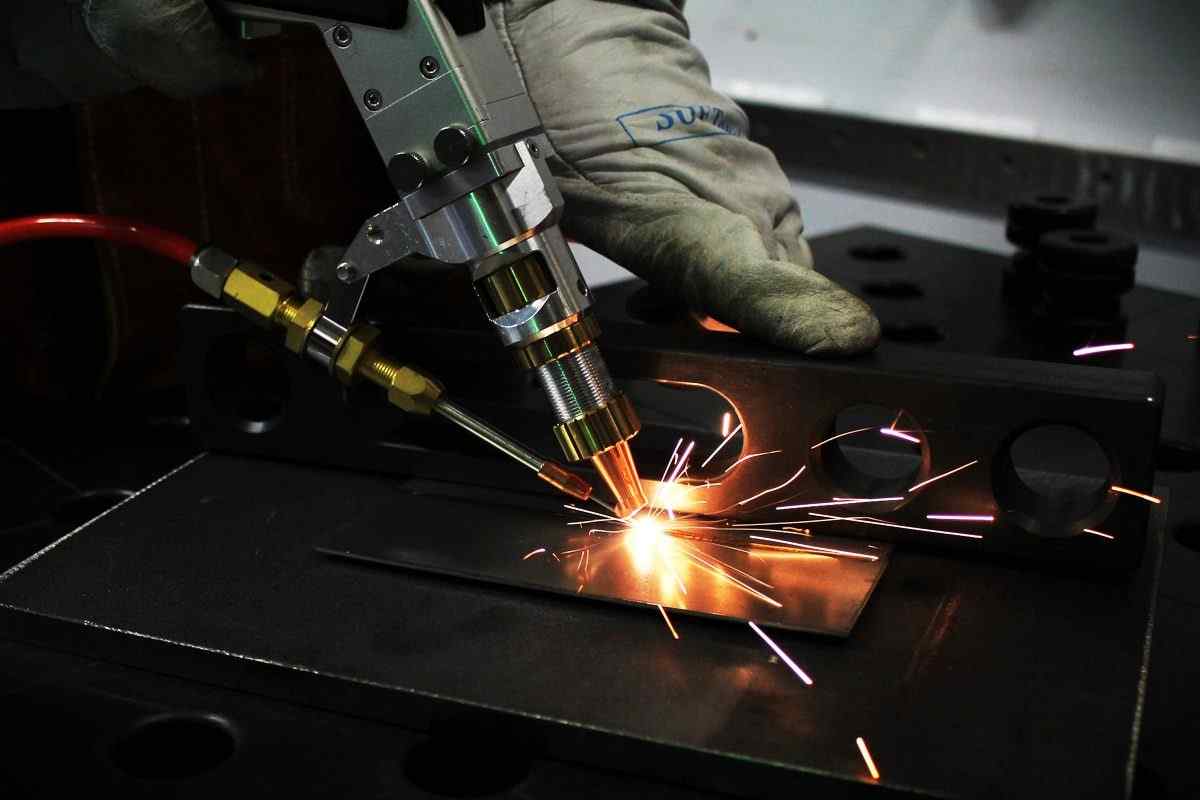
Currently, in the world of welding, there is a strategic shift toward high-precision automated welding in industrial and medical applications. In practical terms, this transition has moved from being a strategic advantage to becoming a fundamental operational requirement. This transition is being driven by a confluence of rising quality standards, labor dynamics, and technological maturation.
The discussion has moved to the forefront because the gap between manual capability and market demand has widened. That is because the traditional manual or semi-automated status quo is facing mounting pressures that make it unsustainable. That’s why modern welding techniques for micro and precision applications are no longer treated as optional upgrades, but as structural foundation of quality management, especially dealing with medical and high-end industrial sectors.
1. The “Cognitive” Weld: When Machines Start Thinking About the Weld
Let’s challenge a common assumption. Many still think welding automation is simply about speed—more parts per hour, fewer human hands. That’s outdated approach. What we’re seeing now is something far more radical: the weld itself becoming intelligent.
Modern Industrial Laser Welding systems are equipped with high-speed sensors that infuse in-situ process monitoring (or Coaxial Process Monitoring), which is widely considered the “eyes” of an intelligent welding system; watches the weld as it happens—at the exact point where energy meets material.
But observation is only the beginning of closed-loop adaptive control in welding.
Today’s systems can:
- Detect trapped gases, cracks, or inconsistencies and flag any issue instantly.
- Adjust laser power, travel speed, or beam focus mid-weld
- Generate a complete data history for every single weld produced
In industrial sectors—think EV production lines— the benefits are the same. Welding techniques with predictive monitoring can reduce unplanned downtime by up to 40%, preventing costly interruptions in high-volume operations.
So the shift isn’t just automation. It’s machines that actively protect the integrity of production.
2. When Microns Matter: The Industrial–Medical Convergence
Another quiet revolution is happening in scale. Modern welding techniques are effectively dissolving the historical fragmentation of the welding industry where one had to choose between precision, neat welds or structural strength and production speed. That separation is disappearing.
As industries pursue miniaturization—especially in electronics, aerospace systems, and autonomous vehicles—the requirements shift from traditional structural tolerance to micron-level precision, now trying to meet the high reliability standards long found in medical manufacturing.
Consider the new reality:
Aerospace engineers are increasingly working with nitinol (traditionally a preserve for medical applications) for its shape memory and super-elastic properties.
Across board, welding tolerances are shrinking into the micron scale.
Laser systems can now weld wires as thin as 0.0015 inches.
Those numbers matter.
Because once you begin working at that scale, traditional fabrication philosophies collapse. At the micron level, heat distortion, material fatigue, and microscopic imperfections cease to be simple “quality issues” and become existential design problems—meaning if you don’t solve them, the product simply cannot function.
The techniques originally developed to assemble pacemakers and stents are now ensuring the reliability of:
- Autonomous vehicle sensors
- Aerospace micro-electronics
- Satellite instrumentation
In other words, medical precision is becoming the new industrial standard.
3. Micro Laser Welding: The Quiet Technology Redefining Precision Manufacturing
Every technological shift has its enabling capability. In precision manufacturing today, that capability is micro laser welding. Unlike conventional processes that rely on high heat input and physical contact, micro laser welding concentrates energy into an extremely small focal point. The result is a joining method that delivers near-surgical precision.
Medical Device Welding achieves this level of control for the medical device industry, where welding isn’t just about joining parts—it’s about sealing life-critical components like cardiac stents, surgical robotics, and implantable sensors.
However, in the world of medical device manufacturing “immutable audit trail” and “documented manufacturing history” are the pillars of regulatory compliance and patient safety. Thus, outsourcing your welding needs to an ISO 13485cerified company is crucial. Engineers sometimes call it a “digital birth certificate.”
Here’s why engineers and manufacturers are increasingly relying on it:
- Reducing distortion and preserving metallurgical properties
- Allowing components measured in micrometers to be joined reliably
- Good for hard to access geometries- thin cavities, molds, and delicate housings
Also, because laser welding has smaller HAZ, it means:
- Less distortion in surrounding materials
- Fewer secondary finishing processes
- Reduced chemical cleaning and grinding
The result is lower material waste and lower energy consumption.
And there’s another shift happening alongside it: Industries that once ignored environmental control are now adopting clean-room manufacturing environments similar to those used in medical device production.
4. The Human Hand vs. the Robotic Mind
Let’s be clear: manual welding is not obsolete. There are situations where a skilled technician—working with microscopic TIG techniques—remains the best solution. Prototyping, repairs, and tool modifications often demand human judgment.
As such, even with advanced welding techniques, expertise in skill and hand dexterity is crucial in:
- Enhancing flexibility for prototypes and low-volume work
- Lower upfront equipment costs
- Adaptability in experimental manufacturing environments
However, since results vary by operator skill, expertise becomes foundational.
On the other hand, as documentation requirements grow in regulated sectors, production consistency becomes core, robotic laser welding systems address those challenges directly.
They deliver:
- Sub-micron repeatability
- Continuous 24/7 production
- Automated traceability and quality documentation
Such robotic systems are less about replacing people and more about protecting long-term manufacturing stability.
Note: Even with advanced welding technology, the aspect of human expertise doesn’t disappear. They evolve into process architects and system strategists.
In essence, leveraging precision-welding helps manufacturers and builders to transform from reactive, labor-dependent manufacturing to predictable, data-driven excellence. However, the value of this welding transition is not found in a single metric, but in the ability of your welder to marshal synergy of critical gains such as risk mitigation, optimized asset utilization, material efficiency, cost structure, and competitive agility.