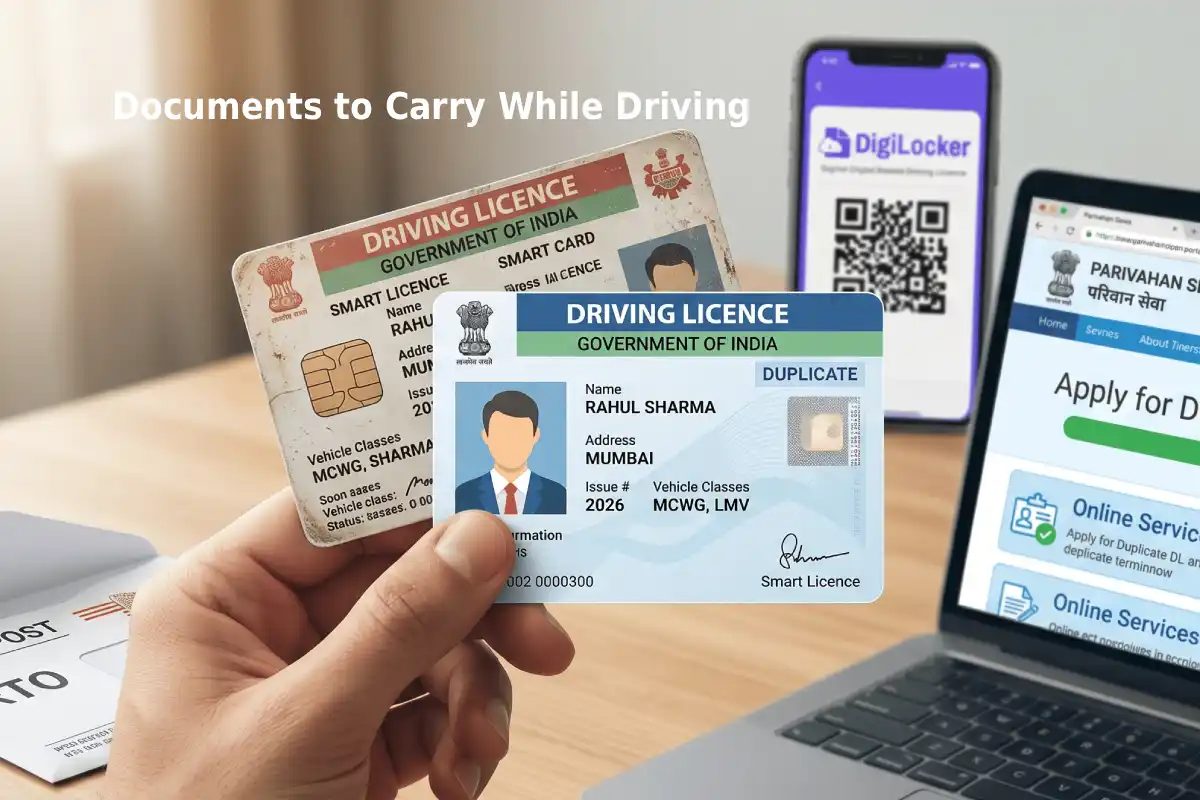
You are stopped by traffic police on a Sunday morning, and they ask for your car documents. You search through your glovebox and find it filled with old bills and papers. In the same pile are your car registration, your license, and insurance policy papers that actually show it expired months ago.
You have all three updated documents on your phone. The question here is: will the police officer accept their digital versions?
Yes, the police will accept them, but many drivers aren’t aware of this. This guide explains which documents you need, which digital versions are legally valid, and which ones will not be accepted.
Documents You Need to Carry
You need to carry four documents for most police stops.
- First is carrying your driving licence valid for the class of vehicle you are in
- Then the registration certificate of the car
- Proof of insurance
- And lastly, a valid pollution under control certificate.
Commercial vehicle drivers need to carry two more documents, one of which is the permit and the other is the fitness certificate, but private car owners rarely need either. Nothing else is compulsory at a routine check.
The class of vehicle is the detail many people miss. Licences endorsed only for a two-wheeler do not let you drive a car, and a learner’s licence requires a qualified driver beside you along with the correct plates, both of which an officer can check in seconds.
The law requires you to show your documents when asked, but you don’t necessarily need to carry physical copies. Under Rule 139 of the Central Motor Vehicles Rules, 1989, these documents can be produced in electronic form, which is a great update for anyone who ever left a folder at home.
Do Digital Copies Actually Count?
Yes, digital copies do count, and two apps can do the job.
The first one is DigiLocker, and the second is mParivahan, both of which are managed by the government. They pull the person’s original document from the government’s database, and a digital record shown through either app is legally equivalent to the printed copy.
Other types of copies, such as photos of these documents in your photo gallery, emails, or photocopies, are not valid. The police cannot verify these against official government records.
If you want to set these apps up it is quick and easy to do so. You just need to enter a few details like your mobile number and Aadhaar or license number, then confirm your details with a one-time password. Once that’s done, the app can pull all your documents automatically from the government’s database. It can even be accessed without an internet connection.
Set up these apps before you need them. When you buy car insurance online, your certificate is usually sent to your account and the transport database within a day or two. This digital insurance certificate is accepted just like a paper copy.
What Does a Missing Document Cost?
Fines went up quite a bit after the 2019 update to the Motor Vehicles Act. Now, driving without a license can cost you about ₹5,000. If you’re caught without insurance, it’s a ₹2,000 fine the first time and ₹4,000 if it happens again, and you could even face jail time.
The consequences can sometimes go beyond just the fine. If you cause an accident without insurance, you are personally responsible for paying all damages awarded to the victim. The amount you might have to pay for serious injuries or death can be very high, with no set limit.
Driving with an expired license is also a risky affair. If you drive with an expired license, your insurance policy might not cover you. This means the insurance company can make you pay back any money they paid to a victim if you get into an accident.
You won’t hear about these serious risks during a simple traffic stop. Constables write a simple challan for a few ₹1000 and wave you off, while the far bigger exposure only surfaces months later if something goes wrong on the road.
What You Do Not Have to Carry
Documents like your policy booklet can stay at home, as the officer only needs to see if a valid cover exists, as the certificate part is what matters at the roadside.
The rest of the document becomes useful at claim time. Any other add-ons you bought, from zero depreciation to a repair cover such as Eco Assure, sit inside that booklet and will be asked about by a claim officer rather than a traffic constable.
Original registration papers are always safer at home. DigiLocker records are enough for the road, and keeping originals at home prevents the long process of replacing them if they are lost or stolen.
Where the System Still Fails You
Connectivity is the obvious weakness. If the signal is very weak, the officer would not be able to check your documents online, which can later even lead to arguments about whether they are valid or not.
Awareness is the bigger gap. Some officers may not fully understand digital rules, so it is better to stay polite and mention Rule 139 instead of arguing.
It’s best to have both options. Use the apps for digital copies and also keep printed copies in your car, and check expiration dates on your phone calendar twice a year.