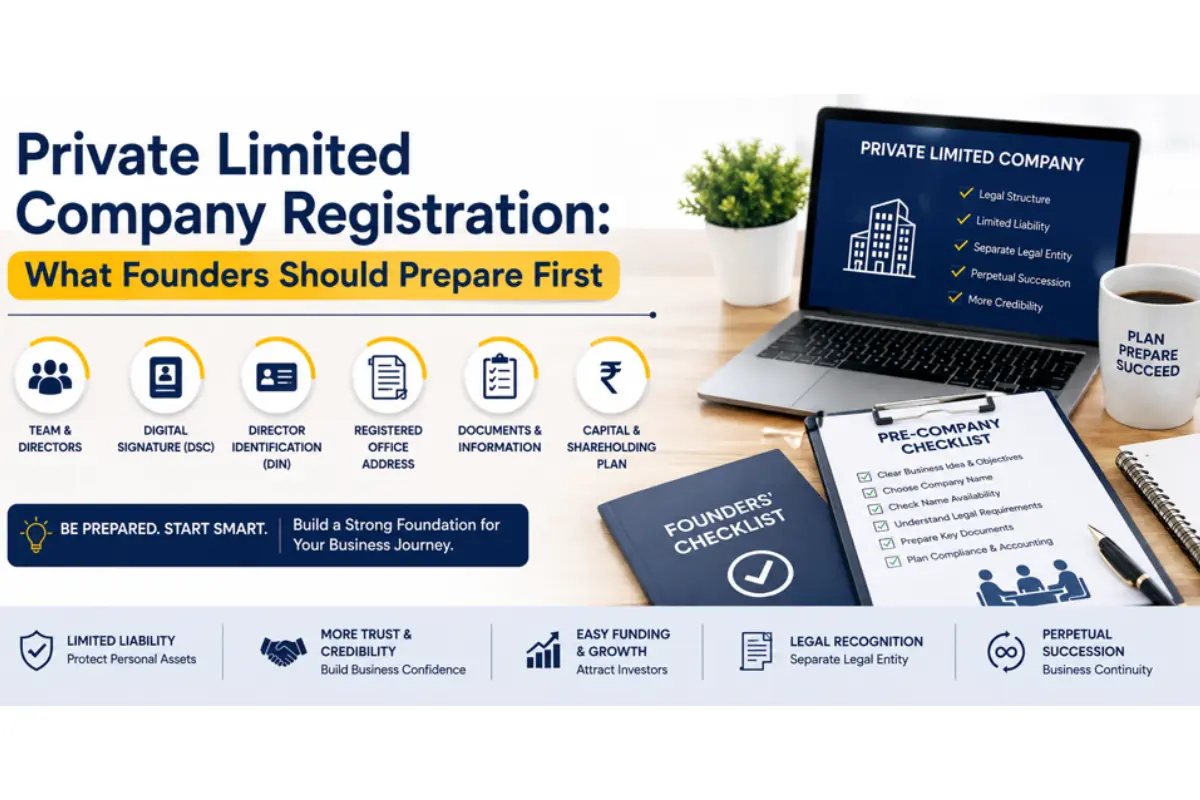
Introduction
Every founder remembers the moment they decide to formalise their business idea into a company. It’s exciting, but it’s also the moment most first-time founders get stuck, not because incorporation is legally complicated, but because they simply weren’t prepared with the right paperwork before they sat down to file.
Company registration in India is now almost entirely digital, routed through the Ministry of Corporate Affairs’ (MCA) integrated SPICe+ web form. On paper, that sounds simple. In practice, incomplete documentation, mismatched addresses, and last-minute name rejections are still the top reasons private limited company registration applications get delayed or sent back with queries from the Registrar of Companies (RoC).
This matters because every day your incorporation is stuck in query-resolution is a day you can’t open a bank account, sign contracts in the company’s name, raise funding, or issue an offer letter under your registered entity. For early-stage founders racing against runway and investor timelines, that delay has a real cost.
What Is a Private Limited Company?
A Private Limited Company is a business entity registered under the Companies Act, 2013, that offers its shareholders limited liability, a separate legal identity, and restricted transferability of shares. Initiating a Private Limited Company Registration is the most preferred route for startups and growing businesses in India because it separates personal assets from business liabilities and is investor-friendly.
Unlike a sole proprietorship or partnership, a registered private limited company acts as a distinct legal person—it can own property, enter contracts, sue, and be sued, all in its own name, independent of its directors or shareholders.
Why Founders Choose the Private Limited Structure
| Feature | Private Limited Company | Sole Proprietorship / Partnership |
| Legal status | Separate legal entity | No separate legal identity |
| Liability | Limited to shareholding | Unlimited personal liability |
| Fundraising | Can raise equity from VCs/investors | Very difficult to raise institutional funding |
| Perpetual succession | Continues despite change in ownership | Ceases on death/exit of proprietor/partner |
| Compliance burden | Higher (ROC filings, audits) | Lower |
| Credibility with banks/clients | High | Moderate to low |
Eligibility Criteria for Private Limited Company Registration
Who can register a private limited company in India? Any individual, Indian resident, NRI, or foreign national, can register a private limited company in India, provided the entity meets the Companies Act, 2013 requirements.
Before you prepare documents, confirm you meet these baseline conditions:
- Minimum 2 directors and maximum 15 directors
- At least 1 director must be a resident of India (someone who has stayed in India for 182 days or more in the previous financial year)
- Minimum 2 shareholders, maximum 200
- A unique proposed company name that doesn’t conflict with existing companies, LLPs, or trademarks
- A registered office address in India (residential addresses are permitted)
- No minimum paid-up capital requirement, you can incorporate with a nominal authorised capital
Documents Founders Should Prepare First
This is the step where most delays happen. Preparing these documents before you start your company registration filing can save you multiple RoC queries later.
1. Documents Required for Directors and Shareholders
| Document | Indian Nationals | NRI / Foreign Nationals |
| Identity proof | PAN card (mandatory) | Passport (mandatory) |
| Address proof | Aadhaar, Voter ID, or Driving Licence | Driving licence or utility bill (notarised/apostilled) |
| Residence proof | Bank statement/utility bill, not older than 2 months | Bank statement, not older than 2 months |
| Photograph | Recent passport-size photo | Recent passport-size photo |
| Digital Signature Certificate (DSC) | Class 3 DSC for all directors | Class 3 DSC for all directors |
2. Documents Required for Registered Office Proof
- Latest electricity, water, or gas bill (not older than 2 months)
- Rent agreement, if the premises is rented
- No-Objection Certificate (NOC) from the property owner
- Property tax receipt or sale deed, if self-owned
3. Documents for the Company Itself
- Memorandum of Association (MOA), defines the company’s objects and scope of business
- Articles of Association (AOA), defines internal governance rules
- Proof of registered office (as above)
- Declaration of the first subscribers and directors
Choosing and Reserving Your Company Name
Choose a name that is distinctive, does not resemble an existing registered company or trademark, and ends with “Private Limited,” then reserve it via SPICe+ Part A on the MCA portal.
Founders can propose up to two name options in Part A, or skip separate name reservation altogether and file Part A and Part B together, the faster route most consultants recommend today.
Naming rules to keep in mind:
- The name cannot be identical or deceptively similar to an existing company, LLP, or registered trademark
- It cannot include restricted words (e.g., “Bank,” “Insurance,” “Stock Exchange”) without regulatory approval
- It must end with “Private Limited”
- Once approved, the name is reserved for 20 days, within which Part B must be filed
Step-by-Step Private Limited Company Registration Process
Private limited company registration is completed by filing the SPICe+ web form on the MCA V3 portal, along with linked forms for MOA, AOA, and optional registrations like GST and EPFO.
- Obtain Digital Signature Certificates (DSC) for all proposed directors, required to sign the fully electronic application.
- Create a Business User account on the MCA V3 portal to access SPICe+.
- File SPICe+ Part A (or combine with Part B) to reserve your company name.
- File SPICe+ Part B, which covers DIN allotment, incorporation details, registered office particulars, and PAN/TAN application.
- Submit linked forms, eMOA (INC-33), eAOA (INC-34), and AGILE-PRO-S for optional GST, EPFO, ESIC, and bank account opening.
- Upload all supporting documents, identity proof, address proof, office proof, and consent forms.
- Pay government fees and applicable stamp duty, which varies by state and authorised capital.
- Track your application using the Service Request Number (SRN) generated on submission.
- Respond to RoC queries, if any, typically within the timeline specified in the query.
- Receive the Certificate of Incorporation (CoI), containing your unique 21-digit Corporate Identification Number (CIN), along with PAN and TAN.
Time Taken and Fees for Private Limited Company Registration
Private limited company registration typically takes 7–10 working days from SPICe+ filing to Certificate of Incorporation, provided documents are accurate and complete.
| Stage | Typical Time |
| DSC issuance | 1–2 working days |
| Name approval (Part A) | 1–3 working days |
| SPICe+ Part B processing | 5–7 working days |
| Total (document-ready cases) | 7–10 working days |
Indicative Cost Components
| Component | Approximate Cost |
| Name reservation (if filed separately) | ₹1,000 |
| SPICe+ Part B government fee | Nil to nominal, depending on authorised capital |
| Stamp duty | Varies by state (₹500–₹10,000+) |
| DSC (per director) | ₹1,000–₹2,000 |
| Professional/consultant fees | Varies by provider |
Risks and Penalties of Getting It Wrong
Errors in your SPICe+ application don’t just delay incorporation, they can trigger resubmission fees, loss of your reserved name after 20 days, and in some cases, rejection requiring a fresh application. Post-incorporation, failing to file mandatory returns like INC-20A (declaration of commencement of business) within 180 days can attract penalties and, in extreme cases, can lead to the RoC striking off the company.
Case Study
A two-founder SaaS startup shortlisted a company name without checking the trademark registry. MCA approved the name reservation, but weeks after incorporation, the founders received a cease-and-desist notice from a company holding a similar registered trademark in the same business class. They were forced to undergo a name-change process, refiling forms, updating PAN, bank records, and client contracts, a process that took over a month and cost significantly more than the trademark check would have. The lesson: a compliant MCA name doesn’t guarantee trademark safety.
Conclusion
Private limited company registration in India has become significantly faster and more streamlined through the MCA’s SPICe+ web form, but speed only works in your favour if you walk in prepared. Founders who gather director KYC documents, finalise a trademark-checked name, and secure valid registered office proof before filing consistently see faster approvals and fewer RoC queries. On the other hand, rushing the paperwork almost always costs more time, and sometimes money, than taking a few extra days to prepare properly.
Getting your company registration right from day one also sets the tone for your compliance journey ahead, from your first board meeting to your first annual filing. When in doubt, it’s worth having a professional review your documents before submission rather than risking rejection or delay.
Why Choose Zolvit
- Expert lawyers and Company Secretaries who handle your SPICe+ filing end-to-end
- CA support for capital structuring, tax planning, and post-incorporation compliance
- Fast processing with dedicated tracking of your MCA application
- Affordable, transparent pricing with no hidden costs
- End-to-end compliance support, from incorporation to annual ROC filings
- Dedicated support to resolve RoC queries quickly and correctly
Frequently Asked Questions
- Can a foreign national be a director in a private limited company registered in India? YES. A foreign national can be a director, provided at least one director on the board is a resident of India who has stayed in the country for 182 days or more in the previous financial year, as required under the Companies Act, 2013.
- Is there a minimum capital requirement for private limited company registration?
- There is no minimum paid-up capital requirement. Founders can incorporate with a nominal authorised capital, such as ₹1 lakh, and increase it later as the business grows and funding requirements change.
- How many directors and shareholders are required?
A private limited company needs a minimum of 2 directors and 2 shareholders, with a maximum of 15 directors and 200 shareholders. The same individual can act as both a director and a shareholder simultaneously.
- What is SPICe+ and why is it used for company registration?
SPICe+ is the MCA’s integrated web-based form used for private limited company registration. It combines name reservation, incorporation, DIN, PAN, TAN, and optional GST, EPFO, and ESIC registration into a single online filing.
- Should founders apply for GST at the time of incorporation?
It depends on the business. If turnover thresholds or interstate supply requirements apply from day one, founders should apply for GST via AGILE-PRO-S during incorporation itself to avoid a separate registration process later.